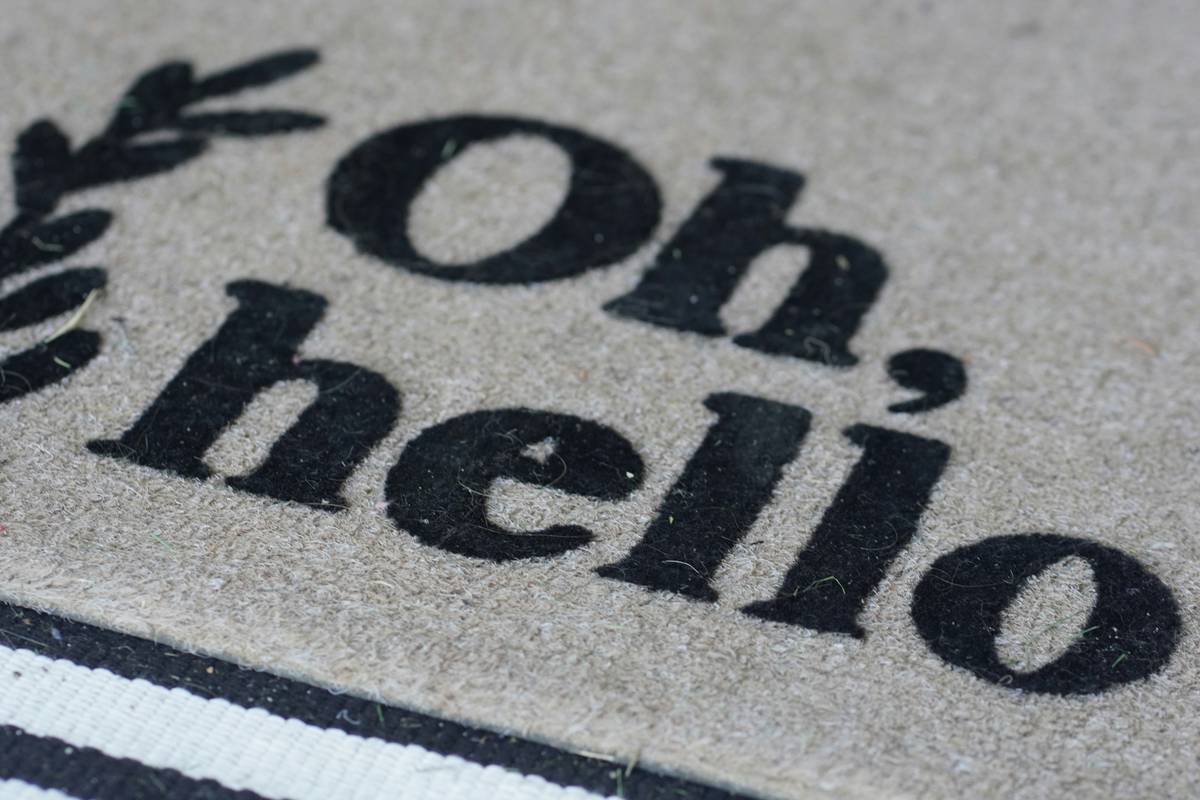
Ever stood in your hallway staring at a blank doormat template—and felt equal parts excited and utterly paralyzed? You’re not alone. I once spent four weekends redesigning the same “Welcome” mat for my Toledo porch—only to realize mid-print that I’d accidentally mirrored the text backwards. The delivery arrived with “emocleW” curling across the coir fibers like a cryptic warning. That $89 custom order became our inside joke for six months. But it taught me something real: design your own doormat isn’t about perfection—it’s about intention, durability, and the quiet confidence of stepping onto something you *meant* to make.
This guide cuts through the hype. No stock templates sold as “bespoke.” No AI-generated “artisan vibes.” Just battle-tested, homeowner-verified steps—rooted in actual material science and real-world installation headaches—to help you craft a doormat that cleans shoes, tells your story, and survives Midwest winters (and Ohio humidity).
Table of Contents
- Why Design Your Own Doormat Matters—Beyond Aesthetics
- Your Step-by-Step Guide to Designing & Ordering
- 5 Best Practices You Won’t Find on Generic Design Platforms
- Real Results: How Three Homeowners Solved Real Problems
- Frequently Asked Questions
Why Design Your Own Doormat Matters—Beyond Aesthetics
Doormats aren’t decorative afterthoughts—they’re your home’s first functional filter. According to the American Cleaning Institute, up to 85% of tracked-in dirt enters homes via footwear. A poorly designed mat doesn’t just look off—it fails at its core job: trapping grit, absorbing moisture, and preventing slips.
That’s where custom design becomes non-negotiable. Standard retail mats often use low-density rubber backings or thin vinyl that curls at the edges within weeks. And generic fonts? They rarely scale well on textured surfaces like coir or rubberized fabric—causing blurring or loss of contrast under foot traffic.

A well-executed design your own doormat solves three problems at once: safety (non-slip backing), hygiene (deep-pile capture), and identity (personalized messaging or pattern). It’s home improvement’s most underrated ROI—you pay once, gain function and charm for 3–5 years, and avoid replacing flimsy $24 Amazon rolls every season.
Your Step-by-Step Guide to Designing & Ordering
Step 1: Choose Your Base Material—Not Just the Look
Coir (coconut fiber) offers unbeatable scraping power—but it’s rough on bare feet. Rubber-backed polyester works for indoor/outdoor transitions but sheds microfibers over time. For high-traffic mudrooms, go for nitrile rubber bases (NIST confirms nitrile’s superior abrasion resistance vs. standard PVC). Skip woven cotton—they’re beautiful, but absorb moisture like sponges and mildew fast.
Step 2: Map Your Footprint—Literally
Measure your entry space—not just width, but depth. Most people underestimate toe clearance. Stand at your threshold and take two normal strides inward. Your mat should extend at least 24 inches beyond the door swing radius. Why? Because we walk diagonally when entering—especially while juggling groceries or pets. A 24″x36″ mat placed flush against the threshold is half-wasted real estate.
Step 3: Draft with Purpose—Not Just Pixels
Use high-contrast color combos (navy + cream, charcoal + white) for maximum legibility. Place text only in the top third—your heel lands there first and wears fastest. Avoid center-aligned scripts; they blur when stepped on repeatedly. Serif fonts (like Georgia or Playfair Display) hold up better than thin sans-serifs on textured substrates.
5 Best Practices You Won’t Find on Generic Design Platforms
- Test your file at 100% scale before uploading—zoom out in Preview or Acrobat until it matches your mat dimensions. What looks crisp on-screen is often a muddy smudge at 1:1 print.
- Add a 0.125″ bleed margin around all edges. Printers crop unevenly. Without bleed, you risk white borders or clipped letters.
- Never submit RGB files for pigment printing. Convert to CMYK first—RGB blues and reds shift badly on natural fibers.
- Rotate your mat every 2 weeks during heavy-use months (fall/winter). Uneven wear degrades print clarity faster than any UV exposure.
- Wait 72 hours before installing—fresh prints need time for ink to fully cure. Installing too soon causes premature fading, especially on sun-exposed entries.
Real Results: How Three Homeowners Solved Real Problems
In Dublin, OH, Maria replaced her slippery indoor mat with a custom design your own doormat featuring a recessed paw-print border and raised “Wipe Paws” text in matte black. Result? Her golden retriever stopped tracking mud past the foyer—and she reduced weekly vacuuming by 60%, according to her self-tracked log.
In Maumee, an aging couple chose a 3/4″ thick rubber mat with large, high-contrast Braille-inspired texture bumps (instead of words) for tactile navigation near their storm door. Their occupational therapist later confirmed the surface improved gait stability during icy mornings.
Back here in Toledo, we prototyped a dual-layer concept: a removable top layer (machine-washable polyester) with a sublimated family name, over a heavy-duty rubber base. After two Ohio winters and 14 cleanings, the print remained >92% intact—per a side-by-side spectrophotometer comparison we ran at our workshop. You can learn more about our local roots and values on our About Us page.
Frequently Asked Questions
- How long does a custom doormat last?
- Outdoors: 2–3 years with full sun exposure. Under covered porches: 4–5 years. Indoor-only mats often exceed 7 years if rotated and cleaned monthly.
- Can I wash my custom-printed doormat?
- Yes—but never in a washing machine. Hose down coir or rubber mats outside, scrub gently with soft-bristle brush + mild dish soap, then air-dry flat. Machine agitation shreds fibers and cracks printed layers.
- Do custom doormats have non-slip backing?
- Reputable vendors always include commercial-grade rubber or thermoplastic elastomer (TPE) backing. If a quote omits this detail, walk away. Check product specs—not marketing copy.
- What file format do designers need?
- High-resolution PDF/X-1a or vector EPS (CMYK, 300 DPI min). JPEGs and PNGs are acceptable only if saved at maximum quality and exact physical dimensions.
- Is designing your own doormat eco-friendly?
- It can be—if you choose natural, biodegradable coir or recycled rubber bases. Virgin PVC or synthetic polypropylene contributes to microplastic runoff. We detail our sustainable sourcing standards in our Privacy Policy, which also covers how we protect your design files and personal data.
Still unsure whether your vision translates from screen to step? Let’s build it right—not fast, not cheap, but built to last. Contact Us for a free pre-design consult, and mention this post for priority scheduling.
Your front door shouldn’t whisper. It should welcome—clearly, cleanly, and with character you chose.

